Sunday, 26 August 2012

Summer diggin'... Part 2

So, one day back home to wash and re-pack my case, and I was on my plane to Spain...


I stayed for 3 weeks in total around Catalonia, originally to dig on a site with the University of Barcelona. This was also part of the fieldwork requirements for my course.  First day, I travelled to Sants Station and found the hostel where I spent the night.  However, I ran into a bit of a pickle on my second day in Barcelona; as soon as I met the dig supervisor, he told me as we drove north that due to the Spain's current economy and the knock-on effects, the Uni had run out of money for the site funding and the dig was cut to 1 and a half weeks. Oops. Bad for my requirements, and also meant I had nowhere to stay for a week and a half.  But I was in a Zen mood and decided that stuff would figure itself out.


Montlleó (France in the background)

The site is thought to have been a key crossing point in the Pyrenees 15,000 years ago in the early and middle Upper Paleolithic, here called the Magdalenian. In fact, the site was initially dated by the Oxford Radiocarbon Lab. What really attracted me to this site was the prospect of finding such old evidence of human occupation in this area, like the perforated shells that they've previously found here. So I was very happy when a perforated shell was found when we were excavating.  We also found a cut straight snail shell (caracol, en español), animal bone and worked flint, and what may be evidence of a hearth.  However, we'll have to wait til the results are published to find what it all means (and I'm not allowed to say too much here!).  What I can say is that the site is a very curious mixture; it is 1130m above sea level but an open site - extremely hot but with a breeze; it's also on a slope, making it hard to excavate evenly!

Team photo

Ger, Cerdanya, where our hotel was near the excavation

The site!

Eve with one of the shells

Unfortunately, I felt ill after about a week, collapsed on the lobby floor and was in bed for a day and a half. By this time, the dig finished and I found myself by the grace of the wonderful students there being put up by Silvia, a lovely student who lives in an apartment in Badalona. Thank goodness they're so nice! The original plan was that I was going to work in the Uni labs for the next week and a half doing post-excavation work, but this was abandoned since a) they'd finished all the work there and b) it was closed. El problema segunda. Nevermind - instead, I hung out with Silvia and her boyfriend and we went sight-seeing and shopping (perhaps a kind of cultural anthropological study, no?) in Barcelona and Badalona.
Olé olé olé!

Chillin' with Silvia and Marta at Badalona beach

La Sagrada Familia

Parc Guell

Oh, and we visited Port Aventura. What can I say? I like to make the best of a bad situation...!

Us at Shambala!

I also met up with my godparents who happen to live close to Barcelona. They showed me the botanic gardens and the Olympic Stadium for the 1992 Barcelona Olympics, all this while the Olympics were going on back in England.

Part of the Olympic park

Silvia took me clubbing in Barcelona too - different, but amazingly fun! I could say it was an anthropological experience too, but I had probably drunk enough calimocho that my amount of dancing far outweighed any critical observations I could have made. However, there is apparently (I say this because I googled it) an anthropologist at the New University of Lisbon whose post-Ph.d work explores "seduction techniques" in nightclubs. And you thought I made up these things. You can read one of her papers here: http://www.inter-disciplinary.net/wp-content/uploads/2011/08/lamygpaper.pdf 

At the end of my trip, I was very reluctant to leave Spain, its glorious sunniness and its wonderful people and its interesting past, but I was glad to stop living out of a suitcase... well, for a little while anyway!

You can read about the site of Montlleó here: http://www20.gencat.cat/docs/CulturaDepartament/DGPC/Documents/Arxiu/Trib03-04.pdf p.23-44 (It's in Catalan so copy and paste it into an internet translator if you can't understand it!)

Wednesday, 22 August 2012

Summer diggin'... Part I

As you can see by the date of my last post, I've been away lately, so sorry to anyone who actually follows this - there are lots of new updates to come, promise...

What's been happening:

  • Last term I was revising for my end of year exams (Hon Mods) whilst training for Summer Eights.  Our crew survived Eights (with some funky stash and some blesséd weather), unfortunately dropping 2 or 3 places but had a brilliant time overall - despite breaking the front of our bow(!) Exam-wise, after a week and a half of living in the library and wondering if I would make it out alive of the exam halls, I passed!

  • For my course I went on a 2-week training excavation at Dorchester-on-Thames, near Oxford.  On the Roman site, at the end of an allotment, the most important find was a Saxon coin discovered by my friend (who received a bottle of bubbly for it!). Digging a cross-section of a ditch we could map the curvature of the ditch, and intersecting ditches with it by identifying what and how much of what we found in it.  For example, different levels of animal bone, its size, and how the bone stuck out of the ground gave a good indication of where the lines could be drawn, as it were. 
Team photo

Unfortunately, our group didn't get to excavate much of the Neolithic site - a great shame for me! We were taught to use total stations, about identifying different pottery (and there was a lot) and how to photo sites.  I also learnt that bathing in a lake isn't so bad (if a bit chilly) since our campsite had no showers, but the pub dinners definitely made up for it.


The Roman site

In all, Dorchester-on-Thames has a lot more history than I thought, and I found some pretty funky stuff; copper coins, nails (all shapes and sizes), Oxford faux-Samianware, and some huge animal jaws. 

Saturday, 9 June 2012

Vampires in Bulgaria

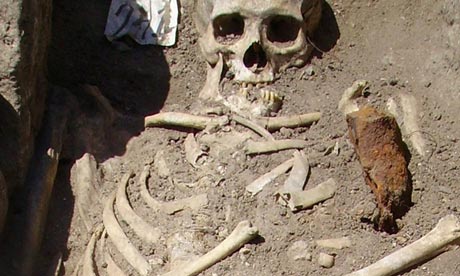
Two Medieval human skeletons found at Sozopol, near the Black Sea in Bulgaria, have been excavated and found to have an iron rod piercing them through the chest.  A little odd, no?

The plot (or should I say clot) thickens: this phenomenon has been found in about 100 other skeletons from the Balkans.  Archaeologist Petar Balabanov in 2004 found six nailed-down skeletons at a site near the eastern Bulgarian town of Debelt according to BBC News.

Bozhidar Dimitrov, from the Bulgarian National History Museum, said "These skeletons stabbed with rods illustrate a practice which was common in some Bulgarian villages up until the first decade of the 20th Century".

According to her, it was pagan practice as a rite to 'pin down' these dead so they would not come back and terrorise the living, in accordance with vampire folklore it seems.

Image courtesy of the National History Museum of Bulgaria/HO/EPA

Well, it's a great coincidence then that a Victorian vampire-slaying kit is going on auction in Yorkshire, isn't it?

Whether or not they were actually thought of as vampires is probably just a media hype.  But I can't wait to get my teeth into the findings when they're published. 

Wednesday, 23 May 2012

Bipedalism, rigging, and gigging

I haven't updated for a while because I've actually been ill for about a month now.  Somehow, I've managed to perform at two gigs in that time.  However, my pesky cough seems to be shifting as well as my cold, just in time for Summer Eights rowing race which starts today! I'm rowing for the college W2 team, and our stash looks great (Hertford stag with golden sunglasses yes please).  Hopefully we'll go bumpity-bump up the table, and the weather looks grand.

My last essay was on the origins of bipedalism.  Having a human bones practical class in the University Museum really helped, and we got to examine real human skulls. I think that's pretty cool, some might say it's creepy. Potato, potaato. One thing I've learnt is the placement of the foramen magnum, the hole which your spinal cord attaches to, on the base of your skull.  If it's anterior (forwardly) placed, it's indicative of bipedalism as the angle shows the person would be standing upright.  However, if it's posteriorly placed, it is likely to belong to a quadruped.  Logical stuff.

The main difference between the walking of human and chimpanzees is that we do it habitually and with a striding gait.  Our walking is formed of the 'swing phase', and the 'stance phase'.


We can 'toe off' using our big toe, which is aligned with the rest of our toes, to push off in the stance phase.  However, chimps have opposable toes, and can't do this.  Their valgus angle of the thigh bone to lower leg bone is also straight.  Our is curved, allowed us to shift the weight of a leg to the other side.


This diagram shows the predicted angle of the australopithecine leg, as a sort of midway between chimp and human angles. However, although it used to be assumed that we can from quadrupeds who strode out into the savannah to see over long grasses, this illusion has been disproved from recent fossil finds.  The contexts of A. afarensis, for example, show that it dies in a heavily wooded area, and not an open grassy savannah at all!  Similarly, research on orang-utans show that bipedalism in an arboreal contexts mostly occurs when trying to maneuver slender, multiple branches.  In fact, it appears that our bipedal ancestors may not have been quadrupeds after all.  Some evidence suggests that adaptations towards bipedalism, because of whichever selective pressures, such as thermoregulation or for food resource attainment, may have actually evolved more than once.  This might explain why some older specimens, such as Orrorin tungensis (6-7 Ma), may like more human like than more younger species like Australopithecines (3.5 Ma).

Being ill, I decided to watch some arch and anth (related-ish) videos... Here's one by Armstrong and Miller on the 'Origin of Teenagers'.  It made me feel a little better.

Wednesday, 2 May 2012

Ötzi's oldest blood

Do you think blood could last 5,300 years on a body? When you're Ötzi the Iceman, it can.
The preserved body of "Ötzi" was found frozen in ice up in the Italian Alps. You might have heard that analysis of the body could determine his sex, his last meal, even the fact he was lactose intolerant. http://www.nature.com/ncomms/journal/v3/n2/full/ncomms1701.html

But now, at the University of Darmstadt, Germany, in the Center for Smart Interfaces a professor and his team are using atomic force microscopy on little slices of skin from an area on Ötzi surrounding the arrow wound which killed him.

How does it work? The BBC summarises it well:
"The technique works using a tiny metal tip with a point just a few atoms across, dragged along the surface of a sample. The tip's movement is tracked, and results in a 3-D map at extraordinary resolution."
http://www.bbc.co.uk/news/science-environment-17909396

They can now reopen the question as to whether Ötzi dies immediately from his wound or days afterwards.
Incredible.

Oh, and apparently, Brad Pitt has a tattoo of Ötzi's outline on his forearm. I wonder if it will survive as long as Ötzi did. I just hope he's not going to get his blood next, because goodness knows what he'll do with that.


Wednesday, 25 April 2012

I'm going to dig in Spain! (Plus questions on hominins)

As you can see from the title, I'm been confirmed a place at a dig in Montlleó open-air site in the summer.  The site is about 2 hours from Barcelona.  It's Magdalenian - about 15,000 years old - and I'll be excavating and digging at the site and analysing lithic remains in the lab for three weeks, all with SERP (http://www.ub.edu/SERP/index.htm). All in all I'm very excited, and even better I'll only be paying for the flight and hopefully the sun will come out! A dig and a tan. What could be better for an Arch and Anth student?

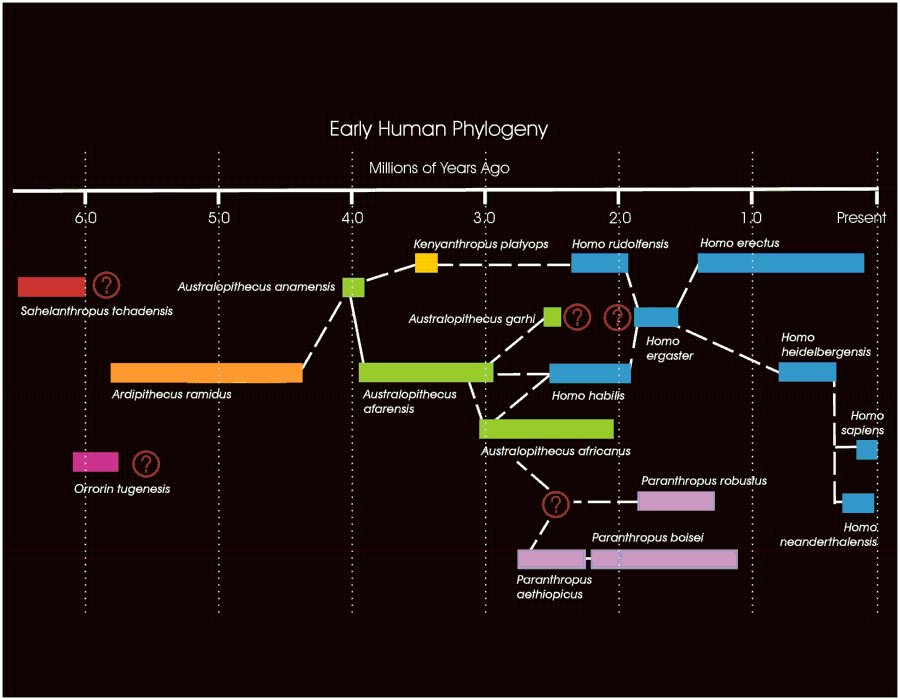
I finished my first piece of work of this term yesterday (excluding my collections and their anxiously-anticipated results) on African Plio-Pleistocene hominins and their characteristics.  We complied a fact-file of hominins from Ardipithecus ramidus (Late Miocene/Early Pliocene - about 5.7 mya (million years ago) to Homo ergaster (African erectus) which is thought to have lived 1.9 million mya.  We also had to draw a lineage of these species and multiple genus, so I got to use my colouring pencils...at last!  I used this phylogeny as my basis, which I first saw from Mike Petraglia's lectures on human evolution.


So I was reassured by my tutor today he uses the same one too (I think it's from the Smithsonian Institute).  So many changes have occurred morphologically in such a 'small' amount of time.  At first I questioned the amount of catergories paleoarchaeologists had 'split' the fossils into; however, this approach is opposed to 'lumping', where you bung a lot of similar-featured fossils together in one group.  There's a lot of debate as to which group some fossils belong to, as you can imagine.  I'm really enjoying learning about my very, very old roots, and still have a lot of questions to ask; what behavioural changes have happened apart from physical ones? Which species did we descend from? Why do I feel so old right now? But questions are good. A recent article in Nature argues against the assumption that Homo habilis was the first to use tools; instead, it might have been Australopithecus afarensis, a gracile Australopithecus found in sites in East Africa.  You can read it here: http://www.nature.com/nature/journal/v466/n7308/full/nature09248.html

It just shows there are many questions about out evolutionary past that are still unanswered. I'd like to answer some of these one day.

Tuesday, 3 April 2012

Rap Guide To Evolution

I'm supposed to be revising for my anthropology paper at the beginning of next term for my collections, but I can't help but admire when someone coincidentally puts any part of my course into a rap.

This is what Baba Brinkman, that dude who rapped Caterbury Tales, is rapping about on his website.  Mark Pallen, the man who writes this blog: http://roughguidetoevolution.blogspot.co.uk/ persuaded him to rap about Darwin too.  I actually really appreciate this, since I'm going to be studying human evolution and biological anthropology next term.  Cheers, guys!

As a bit of a music fan, I also love it when I can revise by singing.  Safe to say I'll be singing this for my Honour Moderations at the end of next term! My favourite one on the website http://rapguidetoevolution.co.uk/ is 'I'm A African', influenced from the original song 'I'm A African' by Dead Prez.  The animation is pretty groovy too in the video (see below).

Next term I'll hopefully be getting more involved in the Oxford University Archaeological Society; maybe we should try to get Baba Brinkman to come give a talk and give us a spin...